
High-ESPmax activators enable uniform room-temperature initiated quasi-solid-state gel electrolytes
GA, UNITED STATES, November 11, 2026 /EINPresswire.com/ -- A room-temperature free-radical polymerization strategy

Press Release Disclaimer: This is a press release distributed through the XPR Media network. It has not been independently verified by our newsroom.
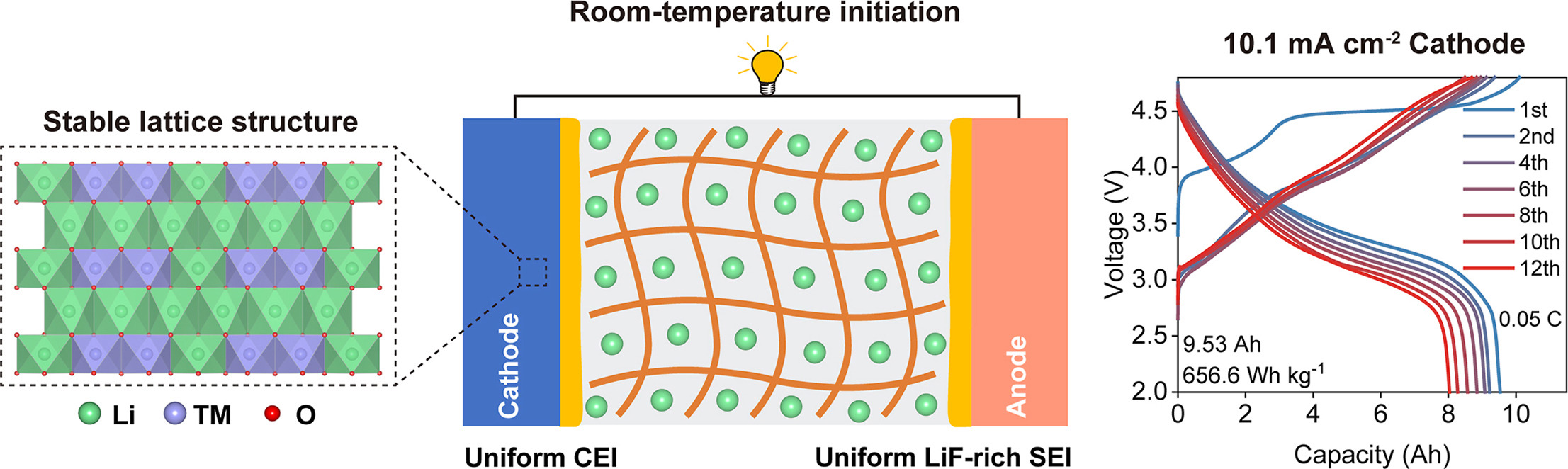

GA, UNITED STATES, November 11, 2026 /EINPresswire.com/ — A room-temperature free-radical polymerization strategy enables the solid-state lithium batteries with improved uniformity and energy density. By introducing activators with high maximum molecular surface electrostatic potential (ESPmax), the approach activates carbon–carbon double (C=C) bonds in acrylate-based monomers, lowering the polymerization barrier and forming quasi-solid-state gel electrolytes (QSEs) inside cells. The resulting room-temperature initiated QSE (RT-QSE) suppresses harmful interfacial side reactions, preserves lithium-rich manganese-based oxide (LRMO) cathode structure and improves electrolyte uniformity. A 4 mAh cm⁻² cathode retained 95.1% capacity after 100 cycles. A 9.53 Ah pouch cell with a cathode exceeding 10 mAh cm⁻² delivered 656.6 Wh kg⁻¹, offering a practical route to high-energy-density solid-state batteries.
Conventional lithium-ion batteries are nearing their practical energy limit of about 300 Wh kg⁻¹, while liquid electrolytes raise leakage and fire risks. Lithium (Li) metal anodes offer a high theoretical capacity of 3,860 mAh g⁻¹ and low potential, and lithium-rich manganese-based oxide (LRMO) cathodes can exceed 250 mAh g⁻¹, making Li-LRMO solid-state batteries attractive. In situ polymerized quasi-solid-state gel electrolytes (QSEs) are promising, but they usually require thermal initiation above 60 °C with azobisisobutyronitrile (AIBN) as initiator. This can cause instant polymerization, heat and gas buildup, uneven solid electrolyte interphase (SEI) and cathode electrolyte interphase (CEI) layers, and electrode degradation. Based on these challenges, further research is needed to develop mild, uniform and electrode-compatible in situ polymerization for energy-dense solid-state batteries.
In a study published online on 20 July 2026 in eScience, researchers at Nankai University and the Haihe Laboratory of Sustainable Chemical Transformations in Tianjin, China, developed a room-temperature free-radical polymerization route for QSEs. The team used high-ESPmax (maximum molecular surface electrostatic potential) activators to activate acrylate monomers and enable uniform gelation inside batteries. Their Li-LRMO pouch cell with a high-areal-capacity cathode delivered 656.6 Wh kg⁻¹, demonstrating a practical path toward energy-dense solid-state lithium batteries and a general design rule for activators and monomers.
The team selected pentaerythritol tetraacrylate (PETEA) as an acrylate monomer, AIBN as the initiator and tris(pentafluorophenyl)borane (TPFPB) as a high-ESPmax activator. TPFPB coordinates with the carbonyl (C=O) group, redistributing electron density away from the carbon–carbon double (C=C) bond and increasing its condensed local softness. Boron-11 nuclear magnetic resonance (¹¹B NMR) showed a shift from −0.07 to 0.66 ppm, and density functional theory (DFT) calculations showed the initiation barrier dropped from 0.46 eV to 0.11 eV. This enabled room-temperature polymerization in both bottles and coin cells. The RT-QSE formed uniform, lithium fluoride (LiF)-rich SEI and CEI layers, supported stable Li plating/stripping for more than 1,200 h at 0.5 mA cm⁻² and 1.0 mAh cm⁻². Atomic force microscopy (AFM) showed a higher Derjaguin–Muller–Toporov (DMT) modulus for the RT-QSE-derived SEI than for the high-temperature QSE (HT-QSE). The RT-QSE also maintained a more stable LRMO lattice without voids or vacancies, while the HT-QSE showed disordered surfaces and uneven interphases. A 4 mAh cm⁻² LRMO cathode retained 95.1% capacity after 100 cycles. Ultrasonic scanning showed better electrolyte infiltration. The 9.53 Ah pouch cell, with a cathode exceeding 10 mAh cm⁻², delivered 656.6 Wh kg⁻¹ and 94.4% initial Coulombic efficiency (ICE).
The authors indicated the advance addresses a long-standing trade-off in free-radical in situ polymerized electrolytes: high temperature speeds gelation but damages interfaces, while room temperature is mild but often cannot start initiation effectively. They said the high-ESPmax activator strategy turns sluggish acrylate monomers into reactive coordination compounds, allowing uniform gelation inside thick electrodes. According to them, the design is not limited to one monomer or activator, offering a practical route to scale up quasi-solid-state Li-LRMO pouch cells. They added that the approach could make solid-state battery manufacturing more uniform and compatible.
The RT-QSE platform could accelerate practical solid-state lithium batteries for electric vehicles, low-altitude aircraft and grid storage, where safety and energy density are critical. Because it builds on acrylate chemistry and can be tuned through activator ESPmax, the approach may fit scalable pouch-cell manufacturing. The authors said low-temperature performance of thick LRMO cathodes still needs improvement through cathode modification and plasticizer engineering. If these issues are addressed, the strategy could help move solid-state batteries from laboratory coin cells and Ah-level pouch cells to practical applicable batteries with more uniform interfaces and longer cycle life. It also offers a general design rule for selecting activators and monomers.
References
DOI
10.1016/j.esci.2026.100626
Original Source URL
https://doi.org/10.1016/j.esci.2026.100626
Funding information
This work was supported by the National Natural Science Foundation of China (22393900, 92372001, and 22121005), Fundamental and Interdisciplinary Disciplines Breakthrough Plan of the Ministry of Education of China (JYB2025XDXM410), National Key R&D Program of China (2022YFB2402200), the Natural Science Foundation of Tianjin (25ZXZSSS00760), and the Haihe Laboratory of Sustainable Chemical Transformations (25HHWCSS00012).
Lucy Wang
BioDesign Research
email us here
Legal Disclaimer:
EIN Presswire provides this news content “as is” without warranty of any kind. We do not accept any responsibility or liability
for the accuracy, content, images, videos, licenses, completeness, legality, or reliability of the information contained in this
article. If you have any complaints or copyright issues related to this article, kindly contact the author above.

Media gallery

